


Weaving Memories of Existence: Chiharu Shiota on What It Means to Live
In conversation with Chiharu Shiota upon her receipt of the Japan Foundation Award
2026.1.23
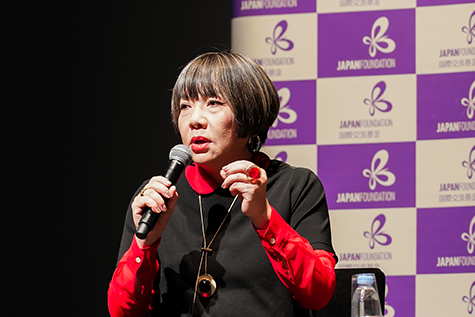
On March 29, 2025, a commemorative talk session was held to commemorate contemporary artist Chiharu Shiota's receipt of the Japan Foundation Award. In a candid on-stage conversation with Mami Kataoka, Director of the Mori Art Museum, Shiota reflected on the emotions woven into her most iconic works, the forces that drive her creativity, and her ongoing dialogue with the themes of life and death. This article traces Shiota's artistic journey and the development of her creative philosophy over the years.
Transformative Years in Germany and the Lifelong Question: Who Am I?
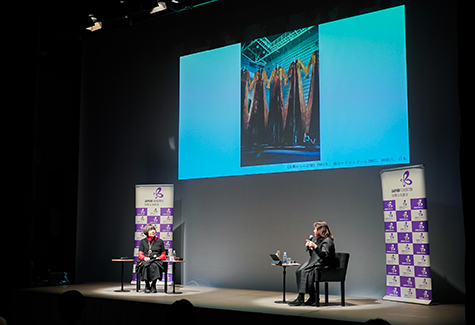
In 2024, Shiota received the Japan Foundation Award, which recognizes outstanding efforts to promote mutual understanding and cultural exchange across borders. From the beginning of her career, she has confronted fundamental themes like life and death with an unwavering focus, pursuing ever-deeper forms of artistic expression. Now based in Europe, she has secured a prominent place on the global art stage.
After graduating from high school, Chiharu Shiota studied painting at Kyoto Seika University. In 1996, seeking to explore broader modes of expression, she moved to Germany.
Shiota was partly inspired to make the move by a friend made during a student exchange program in Canberra, Australia, who mentioned being a student of renowned fiber artist Magdalena Abakanowicz. Shiota had long been captivated by Abakanowicz's fiber art, and sent her friend's university her portfolio and a letter expressing her desire to study under the artist. When the university replied, however, the artist they named was not Magdalena Abakanowicz but Marina Abramović. Her friend had confused the similar names, unintentionally sending Shiota down an entirely new path. That serendipitous error brought her to one of the most influential figures in performance art.
Shiota enrolled at the University of Fine Arts Hamburg, where she began exploring spatial installations and the expressive potential of the human body. In 2000, she transferred to the Berlin University of the Arts in pursuit of more experimental performance work. Under Abramović's exacting mentorship, Shiota pushed herself to her mental and physical limits. In one unforgettable class, the students fasted for five days while confronting their true selves. As Shiota's senses sharpened with her abstinence from food, she wrote a single word on paper: "Japan."
This raw, introspective experience inspired Try and Go Home, a video piece in which Shiota, nude and covered in mud, repeatedly climbs up and falls down the sloping wall of a cavern.
Mami Kataoka (MK): As you cover your entire body in earth, there's a sense of connecting to something deeply alive—something of the soil and land.
Chiharu Shiota (CS): Exactly. And what you can't wash off lingers, becoming a knot in the heart. At the time, I wanted to go back to Japan, but once I returned, I felt completely out of place. Yet when I was away, I missed it deeply. Those complicated push-and-pull feelings are all embedded in the work.
Echoes of Absence: The Lasting Imprint of Childhood Encounters with Death
Shiota's work is deeply rooted in childhood encounters with death. Asked by Kataoka if she'd been drawn to themes of life and mortality since her student years, the artist shared childhood memories of summers spent in the mountain village in Kochi Prefecture her parents were from, where she helped weed her grandmother's grave. At the time, it was common in that area to bury bodies in the ground, and Shiota found it a frightening experience to pull up grass that had grown over buried bodies.
CS: There was something disturbingly vivid about those graves—so vivid that I sometimes wondered if those who had been buried were still alive. It felt as if the grass growing there had sprouted from within the dead. I can still feel that sensation in my hands. Sometimes, while I'm making art, that memory unexpectedly comes back to me.
This early experience is closely connected to the recurring theme of invisible presences and the traces of absence that run through Shiota's work. The quiet tension in her installations and her use of space and stillness evoke the boundary between life and death, presence and absence.
Weaving as a Gesture of Memory and Presence
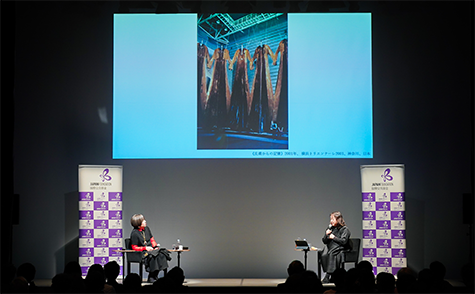
One of her most iconic works is Memory of Skin (2001), with its massive, suspended dresses stained with sludge and water dripping from the ceiling. This evocative composition quietly underscores the traces of memory that cannot be washed away.
In contrast, From-Into (2004) uses static elements like beds and plants in a symbolic visualization of the boundaries between life and death, rest and illness, and dream and reality.
MK: A bed is a place for sleeping, but it's also where life begins—and sometimes ends. It's a symbol of both birth and death.
CS: Sleep resembles death. Sometimes, right before falling asleep, I wonder if I might never wake up. The ambiguous state between dreaming and reality is also where life and death and the real and unreal converge. That's what beds mean to me.
From-Into, one of the early works that included windows, which would later become one of Shiota's signature materials, incorporates over 2,000 windows salvaged from buildings in the former East Germany. For Shiota, windows are a powerful symbol of the connection between inside and outside—a medium bridging past memories and present sensations. Throughout the series of works using windows, she explores themes of urban memory, the memory of home, absence, and human traces as expressed in different spatial contexts around the world.
Neither becoming a mother nor battling cancer could make Shiota stop creating.
CS: If I'm not making something, I feel as if I might disappear. After giving birth, it was like I had two selves—one a mother and the other an artist.
This inner shift, she says, brought new depth and universality to her work.
In this way, Shiota's work begins with personal memory but gradually unfolds into a shared narrative—a story for all of us. Despite the fragility and uncertainty of life, we persist in our daily routines. Shiota's threads bind these individual elements together, giving shape to formless memories and embedding them in the spaces they inhabit.
In 2015, Shiota represented Japan at the Venice Biennale 56th International Art Exhibition with her installation The Key in the Hand. Countless strands of red yarn hung from the ceiling, an old key attached to each one. Shiota had collected more than 150,000 keys from around the world, and every key carried the memories and stories of its former owner. Below the hanging keys, two boats anchored the space like two hands gently catching fragments of memory and existence drifting down from above. The installation was quiet yet overwhelming.
MK: Because each key had once been used by someone, they expressed a kind of presence within absence. Presence and absence have long been themes in your work. The desire to connect with unseen others is palpable.
CS: I asked people to send me old keys along with the memories or experiences attached to them. In the end, I gathered 150,000. It felt like I needed that sheer volume to fill the emptiness inside me. Only with that mass of material could what I wanted to express take shape.
Artistic Expression Deepened by Recurrence
In 2019, Chiharu Shiota held her largest solo exhibition to date, Shiota Chiharu: The Soul Trembles, at the Mori Art Museum in Tokyo. Yet the day after curator Kataoka invited her to stage the exhibition, Shiota received devastating news: her cancer had returned. Looking back, she describes the experience as like being thrown from heaven into hell.
As part of the exhibition, which also served as a retrospective of her early work, Shiota initially proposed new works that directly addressed her illness—one featuring photographs taken by her partner documenting the loss of her hair during chemotherapy and another using the vinyl infusion bags from her treatment. However, Kataoka repeatedly declined the proposals, telling her, "It's too raw—it hasn't been transcended to art."
Instead, Kataoka urged her to create something that would not be viewed through the lens of sympathy for her illness—work that could stand alongside the rest of her oeuvre, encapsulating her 25 years of artistic practice. Encouraged by this advice, Shiota turned inward, confronting the question: When our body disappears, where does our conscious self go? Giving form to what cannot be seen became her focus. After many years contemplating the boundary between life and death, the recurrence of her illness drove Shiota to take her work to an even deeper, more elemental level.
Created for the Mori Art Museum exhibition, Out of My Body gives form to the fear of one's physical body disintegrating while the conscious self remains. The installation features a suspended net-like structure made of cowhide, beneath which lie bronze body parts modeled on those of Shiota herself.
Connecting Small Memories, reimagines key motifs from her past works—such as a piano, chair, and bed—as miniatures. The idea was sparked by a moment when Shiota looked out from the 53rd floor of the Mori Art Museum and saw the city below. From that height, the city appeared as a tiny model.
CS: People, buildings, everyday life—it all looked like a miniature. I juxtaposed that with the small furniture in my studio and reconstructed the story of my life so far.
In this piece, Shiota uses materials like thread, glass, skin, and sound as traces of invisible elements—memories, the soul, the fragility of existence—which she then weaves into the space. Perhaps, rather than rejecting death as an endpoint, the piece gazes stilly beyond it.
MK: I believe everything you have strived to achieve is distilled within that tiny world of miniatures.
Creating as a Way of Being
Today, Chiharu Shiota continues to participate in exhibitions and projects around the world from her base in Berlin. Her quiet yet powerful works touch on themes of memory and absence, the body and time, and the very essence of existence, which resonates deeply with viewers.
Asked if she is often asked about specifically Japanese elements in her work, Shiota reflected on her creative identity:
CS: I want to be Chiharu Shiota before being labeled a Japanese artist. If people sense "Japaneseness" in the work I create, then that too is a valid interpretation."
Much of Shiota's creative inspiration, she explained, comes during transitory moments—looking up at the sky, jotting down passing impressions, or capturing scenes in quick sketches. However, the pandemic forced her to turn the focus of her practice inward, drawing on her daily life at home during lockdown.
CS: During the pandemic, I spent a long time shut inside and ended up creating hundreds of drawings. I counted up to 300, but I lost track after that. I enjoyed the process, but I think the anxiety of not knowing what the future held and the frustration of having nowhere to direct those feelings is readily visible in my linework.
MK: The fear of not knowing what lies ahead, the anxiety of wondering where you're headed—these seem to be driving forces in your work.
CS: It's precisely because of that fear that I can create and retain my sense of self.
Uncertainty and illness, Shiota explained, are both essential to her creative process.
CS: Without that fear, or the experience of illness, I wouldn't be able to make art. For me, creating is a kind of therapy. Exhibitions give me a sense of purpose. I want to keep doing this for the rest of my life. Of course, artists don't create because someone asks them to. Even when no one asks, we're driven by ideas that come from deep within. Still, when I'm working alone in the studio, it's often hard to bring a piece to completion. That's why having a deadline for an exhibition is so important for me.
Shiota's works are painstakingly crafted through a labor-intensive process: tying threads, knitting them together, stretching them across space, and assembling objects into installations. Despite the availability of tools like AI and lasers, Shiota deliberately chooses to work by hand.
CS: It is the age of AI, so I suppose I could use lasers instead of thread. But for me, that would leave my inner fears and knots unresolved. The instability I carry inside—my feelings of uncertainty about my own existence—would only grow.
The countless threads that Shiota has stretched across spaces around the world are more than just material installations. They give form to the invisible, asserting "I am here."
Each of Shiota's works stands as a testament to her existence and, in turn, gently stirs memories and emotions that lie dormant within those who view it.



Keywords
Back Issues
- 2026.3. 3 Busan as a Bridge: R…
- 2026.3. 3 Bridging 100 Years o…
- 2026.1.30 Crossing Borders thr…
- 2026.1.23 Weaving Memories of …
- 2026.1. 6 How Japanese-Languag…
- 2025.12.25 Peace Actions Envisi…
- 2025.9.30 The 51st Japan Found…
- 2025.9.30 The Japan Foundation…
- 2025.9.30 Bringing the World C…
- 2025.9.30 The 51st (2024) Japa…