


How Japanese-Language Education in Malaysia Led Me to Community Co-Creation

The Japan Foundation (JF)'s NIHONGO Partners (※) initiative places Japanese citizens as assistants to local Japanese-language teachers at secondary schools across Asia, providing classroom support and introducing Japanese culture. As a third-year university student, Rin Miyakawa joined Malaysia 4th batch and was dispatched to Perlis, Malaysia's northernmost state. She now works at Nankai Electric Railway Co., Ltd., engaging in multicultural-coexistence projects with foreign residents along the railway line. What did she gain from her 10-month stay? We spoke with her about the career she built after NIHONGO Partners.
※The NIHONGO Partners dispatch program, launched by JF in 2014, is open to Japanese citizens aged 20-69 without requiring special qualifications or prior experience. To date, approximately 3,700 participants have been dispatched to 14 countries and regions.
Captivated by the Architecture of Kyoto's Nijo-jo Castle,
a Childhood Enchanted by Japanese Culture
- ――When did you first become interested in international exchange?
-
I'm a kikoku shijo (returnee to Japan) and lived in the United States when I was little. When I returned to Japan for the first time at 7, I still clearly remember how moved I was as we drove past Nijo-jo Castle in Kyoto. The streets were beautiful, and it made me so happy to realize that a country with such remarkable architecture and culture was my homeland. From then on, I wanted to learn more about Japan and share its appeal with people around the world.
After that, I entered Osaka University's School of Foreign Studies, majoring in Japanese. My seminar professor told me about JF's NIHONGO Partners program. In my faculty, there are many students who study abroad in their third year, but rather than language study, I was interested in NIHONGO Partners, where I could teach Japanese and Japanese culture and gain something extra, so I applied.
- ――Why did you choose Malaysia?
-
I was interested because, although it is a multiethnic, multicultural, multireligious country of mainly Malay, Chinese, and Indian communities, they live alongside one another in relative harmony. As part of the NIHONGO Partners Malaysia 4th batch, I took a leave of absence in my third year and was dispatched for about 10 months to Perlis, near the border with Thailand.
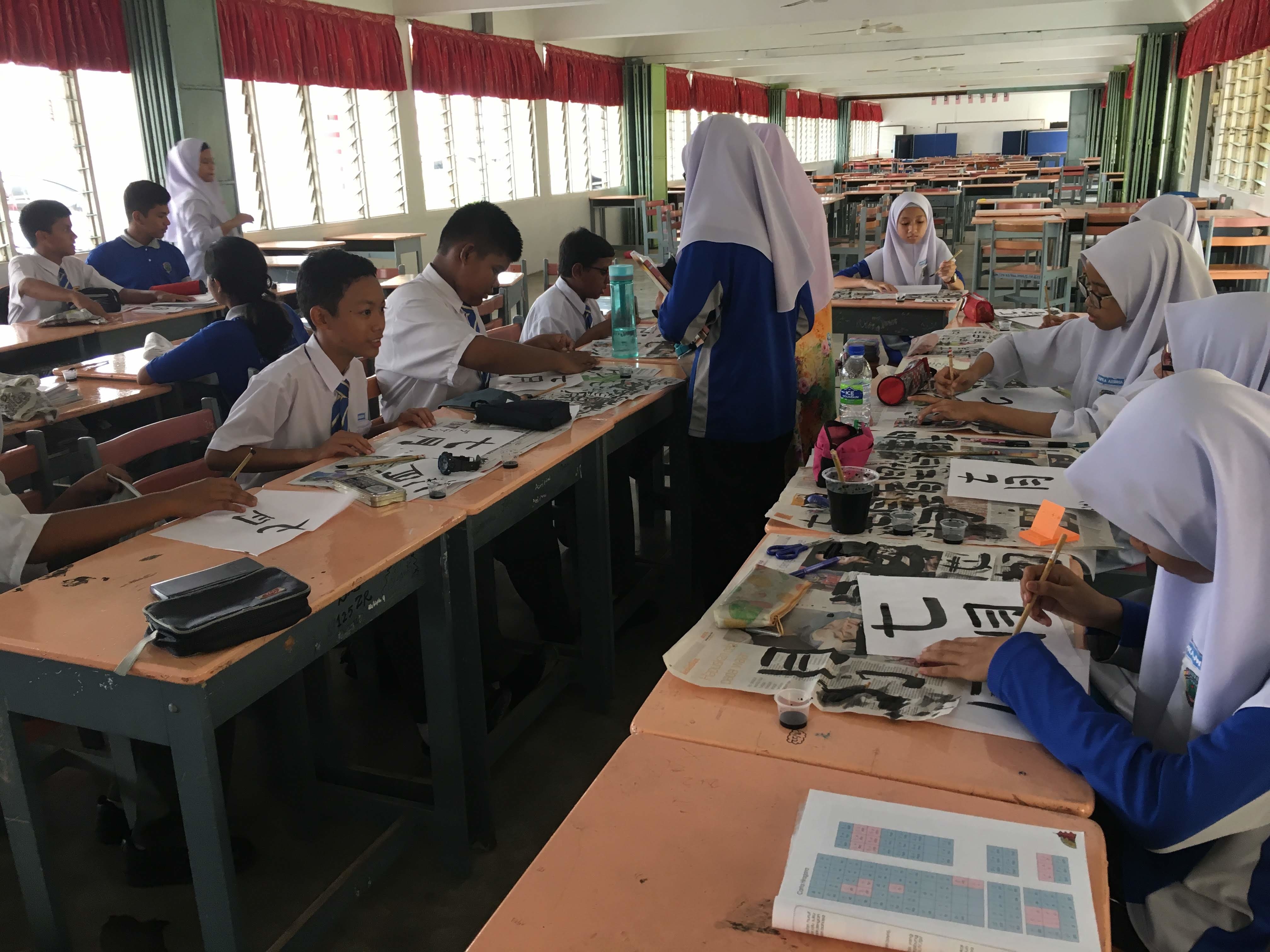 Perlis, Malaysia's northernmost state; secondary school students pick up their brushes for an experience of Japanese during a calligraphy lesson. (Photo courtesy of Rin Miyakawa)
Reaffirming My Path
During My Stay in Malaysia
- ――What kind of activities did you do on site? Could you share a memorable episode?
-
I supported classes as an assistant to local Japanese-language teachers. I worked with upper elementary and junior high students, modeling Japanese pronunciation as a native speaker and sharing the appeal of Japan. When I first handed out a survey to the students about what they wanted to learn, I expected many to be interested in anime and games, but the results showed admiration for Japan as a technological powerhouse and strong interest in work. I was surprised by how many said they wanted to go into science and engineering in the future.
My very first day at school is a particularly happy memory. As I walked down the corridor with a teacher and waved to the students lined up on the other side, they gave a cheer of welcome. Perlis, at Malaysia's northernmost tip, is about 5 hours by KTM (Malaysian Railways) express from the capital, Kuala Lumpur. It's a rural provincial city with few foreign residents. Perhaps I was welcomed all the more because I was a rare foreigner, but I was struck by how friendly and cheerful people were.
- ――Did the 10 months you spent there change your career choices or values?
-
My desire to do work that shares the Japanese culture I love grew even stronger. When I was job hunting, inbound tourism was gaining momentum, so I sought a role that would let me communicate to people overseas while living in Japan. As I researched the travel industry, I found myself drawn less to travel companies that promote the appeal of existing tourism resources and more to the railway sector, which also undertakes real-estate-related projects like developing commercial facilities―work where I could "create" something myself. I set my sights on Nankai Electric Railway Co., Ltd. because I felt there was still ample scope for development along its lines, and because it operates the limited express Rapi:t linking Kansai International Airport and Namba in Osaka, where I saw potential for the company to expand its international-facing business.
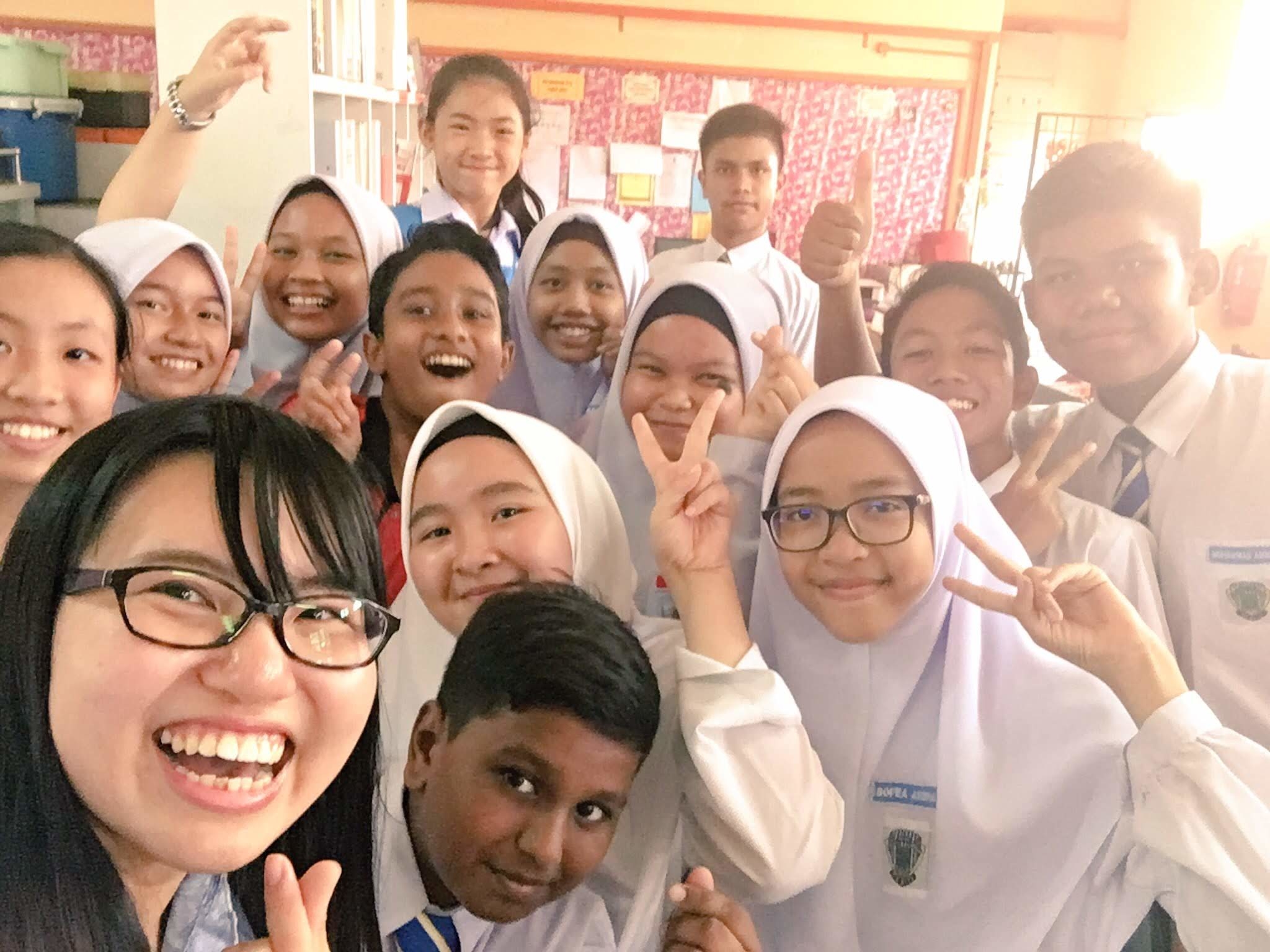 A commemorative photo with students after the final class near the end of her assignment. (Photo courtesy of Rin Miyakawa)
Putting Japanese Culture "Communication" Skills to Work
in Railway Multicultural-Coexistence Projects
- ――You later joined Nankai Electric Railway Co., Ltd. Could you tell us about the work of your current department, the Co-Creation Business Department?
-
One area is attracting overseas groups to industrial tourism (open factories) along the Nankai line―programs where visitors can tour or experience production sites at small and medium-sized manufacturers. Concretely, we target overseas business associations and university seminar groups that want to learn about Japanese manufacturing during study visits. In 2024, I was also involved in tourism promotion for Koyasan to mark the 20th anniversary of its World Heritage inscription. In response to visitors' questions―such as "How can we best enjoy Koyasan?"―we created a website introducing about 30-40 locations, including temples and shrines on the mountain, as well as eateries and souvenir shops.
 An autumn joint field trip hosted by Nankai Electric Railway Co., Ltd. to encourage exchange between international students from the First Study Japanese-language school, Japanese students, and Wakayama University students along the Nankai line. Photo courtesy of Nankai Electric Railway Co., Ltd.
- ――As a measure to enhance value along the railway, you're also working on sustainable community building under the strategy of "coexistence with non-Japanese people," correct?
-
At Nankai Electric Railway Co., Ltd., to make our service area a place where non-Japanese people can settle alongside Japanese communities, we focus on what we call the "three shoku," each a homophone distinguished by different characters in Japanese: work, food, and interaction. For work, we collaborate with an employment-support organization in Fukuoka that assists international students, pairing their services with our network of companies along the Nankai line. For food, near Kongo Station we've seen a growing Nepalese community with demand for familiar spices and seasonings, so with cooperation from LOVE NEPAL in Osaka we helped bring in a South Asian grocery and restaurant. And for interaction, that shop hosts monthly events where people can experience Nepalese culture. These gatherings bring together international students, university students along our lines, and local residents, and a multicultural community is gradually taking shape there.
 "My fellow NIHONGO Partners in the same batch are all so distinctive and interesting--they continue to inspire me," says Miyakawa.
- ――Do you find that your NIHONGO Partners experience is useful in your current work?
-
When it comes to intercultural exchange, I realized the necessary skill is not to match the other side 100 percent, but to search for a shared landing point and meet in the middle from both directions. When you live abroad as a foreigner, thinking you must conform to locals can lead you to overextend yourself. Because I've struggled myself, I can understand the difficulties foreigners face in Japan, and I've learned to look at issues―and propose solutions―from both perspectives: the foreigner living in another country and the local residents. What makes the world interesting is that there are many cultures. Precisely because different cultures and ways of thinking exist, I believe new ideas and innovation are born.
- ――Is there anything you'd like to say to readers who are interested in NIHONGO Partners alumni career paths?
-
As an alumna of the NIHONGO Partners program, choosing to work at a railway company rather than become a Japanese-language researcher or teacher may seem unexpected. But in Japan there are many companies involved in international exchange and multicultural coexistence. When you take on a role within them to work on international exchange or multicultural coexistence and change things from the inside, I believe the NIHONGO Partners experience can be fully put to use.
Related Content
Laughter Meets Learning: Breakout Comedian Yiran on the Crossroads between Comedy and Study
Partnership to Co-create a Future with the Next Generation: WA Project 2.0


Back Issues
- 2026.3. 3 Busan as a Bridge: R…
- 2026.3. 3 Bridging 100 Years o…
- 2026.1.30 Crossing Borders thr…
- 2026.1.23 Weaving Memories of …
- 2026.1. 6 How Japanese-Languag…
- 2025.12.25 Peace Actions Envisi…
- 2025.9.30 The 51st Japan Found…
- 2025.9.30 The Japan Foundation…
- 2025.9.30 Bringing the World C…
- 2025.9.30 The 51st (2024) Japa…