


Busan as a Bridge: Re-envisioning Japan-Korea Relations through Japanese-Language Education by Jung Giyoung
2026.3.3
【Special Feature 088 Japan Foundation Prizes for Global Citizenship: Public Roundtable Report】
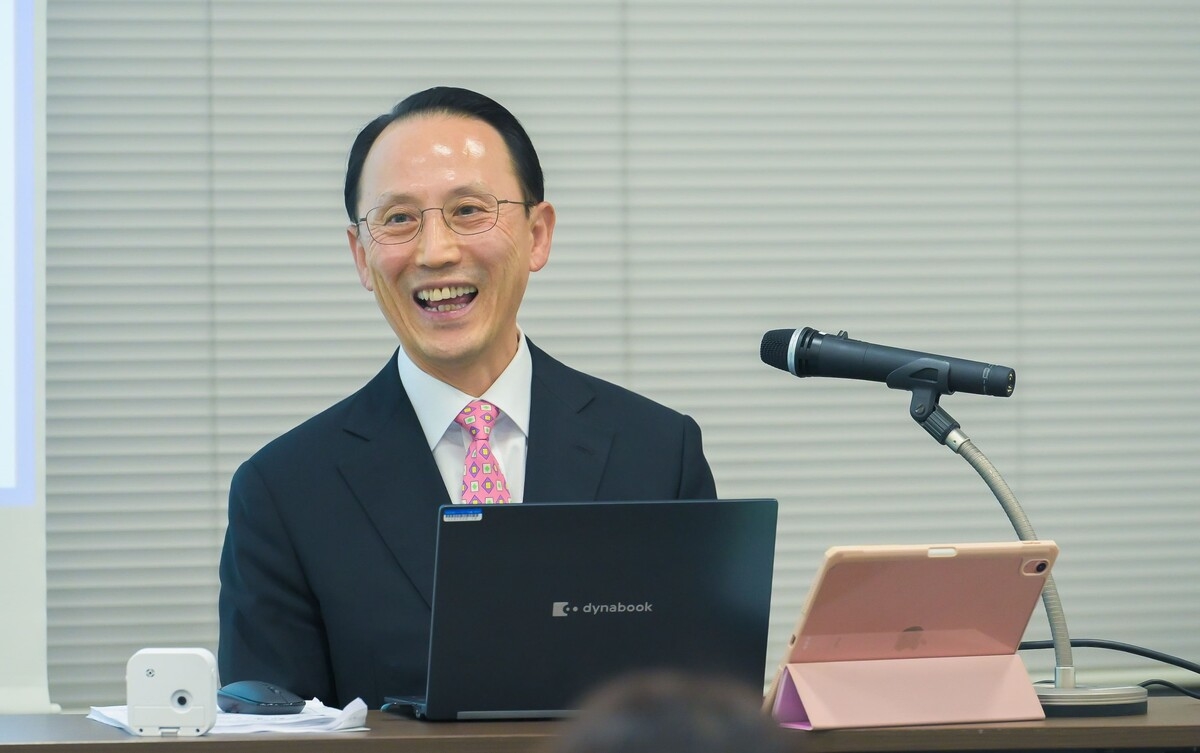
On October 23, 2025, a commemorative lecture was held at Japan Foundation Hall Sakura (Yotsuya) to mark Professor Jung Giyoung of Busan University of Foreign Studies (BUFS) receiving the 52nd (FY2025) Japan Foundation Awards. In the lecture, Jung reflected on the efforts in Japanese-language education aimed at deepening mutual understanding between Japan and Korea that led to the award, tracing his steps from his 1994 faculty appointment through 2025, the 60th anniversary of the normalization of diplomatic relations between the two countries. This article consists of excerpts from Jung's lecture highlighting his initiatives that have strengthened understanding and trust on both sides.
※The full lecture is available on the Japan Foundation's official YouTube channel.
Jung Giyoung, Professor at Busan University of Foreign Studies
A leading figure who has steered Japanese-language education in Korea for over thirty years. At Busan University of Foreign Studies (BUFS), Jung elevated the Japanese major to create a dedicated division and launched new majors in Korea-Japan Cultural Contents, Business Japanese, and Japanese & IT. Under his leadership, the department grew into the Division of Japanese, Korea's largest hub for Japanese-language education, now home to over 1,000 students. Beyond promoting ICT use, he helped spread pioneering methods such as can-do assessment that quantifies learner proficiency. His contributions also extend beyond language education, including beach cleanups of marine debris on Tsushima, job-placement support for Korean students at Japanese companies, heritage-language education through the establishment of the Busan Nihonmura (Busan Japanese Village), and the operation of the Busan Korea-Japan Cultural Exchange Association, with unwavering dedication to bridging mutual understanding and fostering friendship between Japan and Republic of Korea.
Turning Busan into Korea's Largest Base for Japanese-Language Education:
Cultivating Talent to Link Japan and Korea
Busan is Korea's leading trading port and its second-largest city after Seoul. Situated at the country's southern tip, it lies less than fifty kilometers from Japan's Tsushima, and has long been a city where goods and culture flow between Japan and Korea.
I first began studying Japanese forty-three years ago, in 1982, at Busan University of Foreign Studies (BUFS). After studying in Japan and completing my military service, I returned to my alma mater as a faculty member in 1994. When I took up the post, I had two plans. One was to make BUFS an even larger center for Japanese-language education than universities in Seoul. The other was to nurture the growth of many people there who would serve as bridges between Japan and Korea. I saw that as my mission and role.
These plans were grounded in two ideas. First, I believed that today's emotionally charged Japan-Korea relations must be made more rational, and my educational principle has been to train capable people who can help build rational relations between the two countries. If education produces many bridge-builders and broadens the base, Japan-Korea relations will, I believe, become more rational.
The second idea is that quality emerges from quantity. If we train many learners of Japanese, excellent graduates will follow. I thought it would be wonderful if, from a regional city like Busan, we could produce large numbers of graduates who surpass students at universities in the capital, Seoul.
On the strength of these two convictions, I resolved to build a hub of Japanese-language education in Busan.
Educational Reform by Integrating Japanese with Specialized Fields
Meeting Societal Needs through Human Resource Development
 Korean students begin Japanese for all kinds of reasons, from anime to pop culture and more, but lately, Jung notes, an increasing number are drawn by empathy with Japan's diverse values and ways of life.
I was a student in the first cohort of the Japanese Language Department at BUFS, founded in 1982. When I returned to the university as a faculty member around 1994, student numbers were beginning to rise compared with when I graduated, partly thanks to brisk economic exchange with Japan from the 1980s onward. In 1998, Japan liberalized access to its cultural products, and Japanese anime and other culture flowed in rapidly; economic exchange correspondingly grew even more lively.
The number of learners of Japanese increased year by year, and motives have shifted with the times. In the 1980s, when I studied, reasons were largely economic―people wanted to study Japanese to help in their jobs. From the 1990s on, culture led the way: Japanese animation and J-pop, and even what many view as a distinctly Japanese omotenashi (spirit of hospitality). Universities also rushed to open new Japanese programs; around 2000, as I recall, more than ninety of Korea's roughly two hundred four-year universities had a Japanese major.
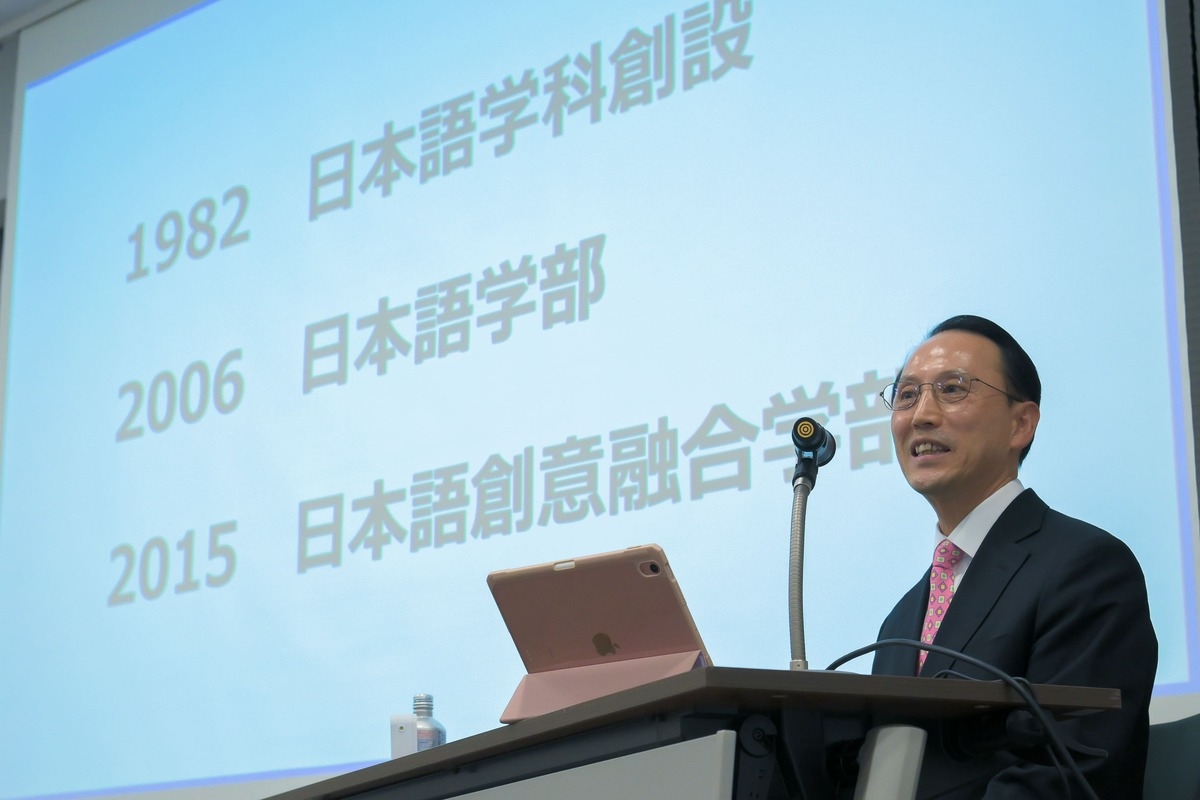
Our Japanese program at BUFS took a major step forward in 2006. As head of the admissions center, I raised the annual intake in one stroke from about 80 to 90 students to 250, upgraded the department to a standalone division, and added a second-major system.
Behind this was the fact that Japanese ability alone was no longer enough to make our graduates competitive in the job market. Even students who hadn't majored in Japanese were increasingly living in Japan or interacting with Japanese people and spoke the language well. So we enabled students to combine Japanese with a second major, specifically, Cultural Content, Interpreting and Translation, Hotel and Tourism Business, and IT. Studying Japanese in combination with these second majors boosted students' competitiveness and ready-to-work skills, and placement rates climbed. Before the program was upgraded to a division, the graduate employment rate was around 60 percent; at its peak, it rose to approximately 80 percent, with about 30 percent finding employment in Japan (in IT and service industries, as well as at general companies). For students majoring in Japanese at Korean universities at the time, these figures were truly remarkable.
This reform stimulated a surge in applications to our Japanese program. We adopted today's name, the Division of Japanese, and at its peak, including minors, more than 1,000 students were enrolled.
That said, when Korean students work in Japan, they need more than Japanese proficiency. First comes the ability to think for themselves. In our school we teach IT and business alongside Japanese, but once on the job they must think independently and keep learning. It is also vital to be able to "observe" and to "read the room." Japanese people often do not readily voice their thoughts, so it is important to look closely at the other person's expressions and respond accordingly.
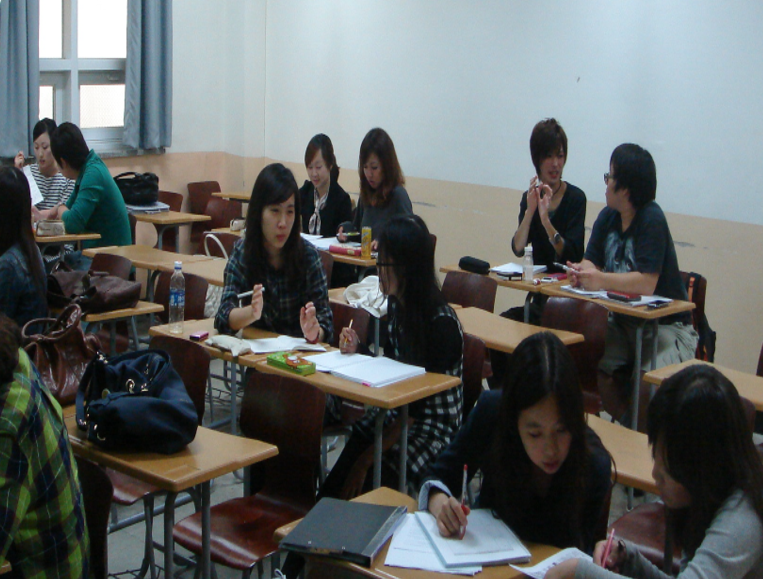 Tandem learning, which involves pairing two students who teach each other their native languages, is offered at BUFS. It develops not only language and communication skills but also friendships. Each year, roughly 1,000 international students are paired with Korean students for tandem learning in Japanese as well as English, Chinese, French, and other languages. (Photo: lecture slide)
 Published in 2012, Jung's book IS rensōhō de 48-pun dake de manabu hiragana/katakana (Kyōshi-yō shidōsho) [Learning Hiragana and Katakana in Just 48 Minutes with the IS Association Method (Teacher's Guide)] appears at center; the cards on either side were created with the IS Association Method. Each card links Japanese characters and pronunciation to visuals with explanations in Korean. (Photo: lecture slide)
From Tsushima Beach Cleanups to a "Japanese Village":
Expanding Practice Beyond Japanese-Language Education
・Coastal cleanups on Tsushima
Since 2003, our school has organized volunteer trips to clean marine debris from the beaches of Tsushima. It all began with a report from one of our graduates who had joined the ferry company linking Busan and Tsushima: residents on the island were struggling with drift waste arriving from Korea. Labels on plastic containers showed Korean origin, but this was not because coastal residents in Korea were dumping trash at sea. Rather, refuse on land was washed by wind and rain into rivers, flowed into the ocean, and was carried by the currents to Tsushima and Nagasaki. Japan's trash is said to similarly drift as far as Hawaii and the US West Coast.
I concluded that if students learning Japanese visited Tsushima to clean the beaches and explain the causes of the drift waste, they could contribute to environmental conservation and rebuilding trust. We crossed to the island with a student volunteer group and began our efforts. Japanese TV programs featured the activity several times, generating a strong response. In 2016 we received a joint ministerial commendation from Korea's Ministry of Education and Japan's Ministry of Education, Culture, Sports, Science and Technology (MEXT) for contributions to Japan-Korea educational exchange.
Additionally, in 2012, we established "Japanese Village" in Busan, a weekend school where children primarily from Japan-Korea international marriages learn Japanese. Beginning in the 1990s, as exchange between Japan and Korea increased and international marriages rose, we began receiving many consultations about issues stemming from differences in culture and in married life.
While I was a visiting professor at Princeton University in the United States, I gave a talk at the Princeton Community Japanese Language School, where children from Japan-US international families study Japanese on weekends. There I realized the importance of children "inheriting a parent's language." Even when one parent is Japanese, children living in the US tend to assimilate into US culture―and in Korea into Korean culture―losing the cultural identity and language that could be inherited from their parents.
From an international perspective, this is a serious cultural loss. To prevent it, children raised in a country different from a parent's country of origin should be actively taught that parent's mother tongue―what is known as heritage-language and heritage-culture education. Korea, too, needs to develop multicultural policies, including such education. We began our activities in Busan, and later similar initiatives were established in Seoul as well.
At first enrollment was small, so although I wanted to call it the Busan Japanese Language School, we named it the Busan Japanese Village instead (laughs). Today, about 35 to 40 children, mainly from international families, come every week to study Japanese. Classes are taught by Japanese mothers and fathers who have devoted themselves to the program for more than ten years. I will continue to support this activity so that places to encounter Japanese language and culture remain available inside Korea.
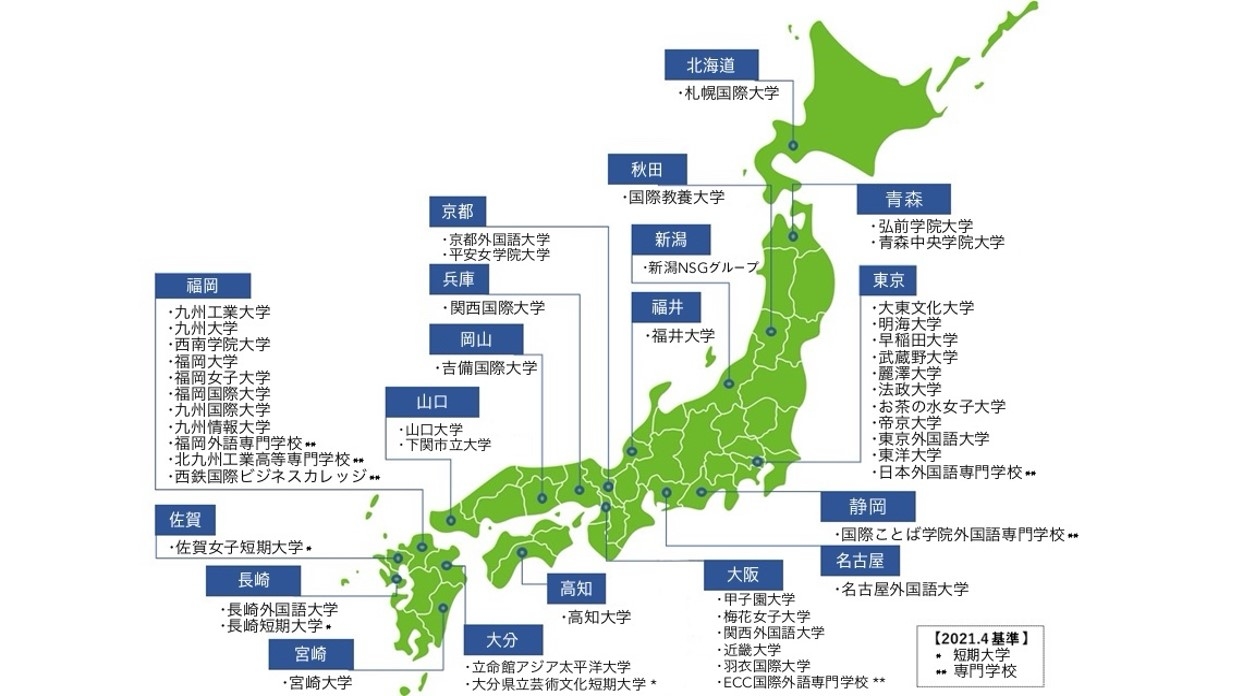 BUFS actively promotes exchange with Japanese universities. As of 2025 it has agreements with 101 universities and institutions in Japan and jointly operates Japanese-language and related programs. (Photo: lecture slide)
From Mutual Understanding to Cooperation:
What Does a Rational Japan-Korea Relationship Look Like?
When I talk about Japan-Korea exchange and relations, I always introduce two sayings.
The first is something said to our students during a beach-cleanup volunteer trip to Tsushima. In 2004, Matsumura Yoshiyuki, the island's first mayor, addressed the students gathered on the shore: "We cannot change the past between Japan and Korea, but we can change the future. Please, be the ones to change it." As someone engaged with Japan-Korea exchange from the educational side, I was deeply moved. Our relationship is easily swayed by emotion, and I struggle with that constantly. But his words made me feel, "That's right. We cannot change the past―and must not forget it―but we can change the future, so there is hope." I have come to cherish his phrase, "We can change the future."
The second is one of my own: "Japan-Korea relations are like a marriage." I feel a bit apologetic saying this in front of my wife and child (laughs), but the point is that "when you premise a relationship on mutual understanding, conflict and friction follow." My wife would often say to me, "Why don't you understand me?" and I would think, "Why won't you understand me?" Yet if I can hardly understand myself, it is all the more difficult for my wife to understand me.
If you make mutual understanding the premise in a relationship with others, the difficulty of achieving it breeds resentment and strife. It is better to acknowledge, "We cannot fully understand each other." Take the positive view that "even if we cannot understand, we can still cooperate," and when problems arise, talk them through―creatively asking where to find common ground and where to compromise. If even that effort is impossible, then all you can do is wait. Given time, people naturally cool down. You may even reach a mindset of "Well, I guess I'll let it go this time." I believe this holds true for individuals and for nations alike.
This is what I mean in education when I say I want to build not an emotional Japan-Korea relationship but a rational one.
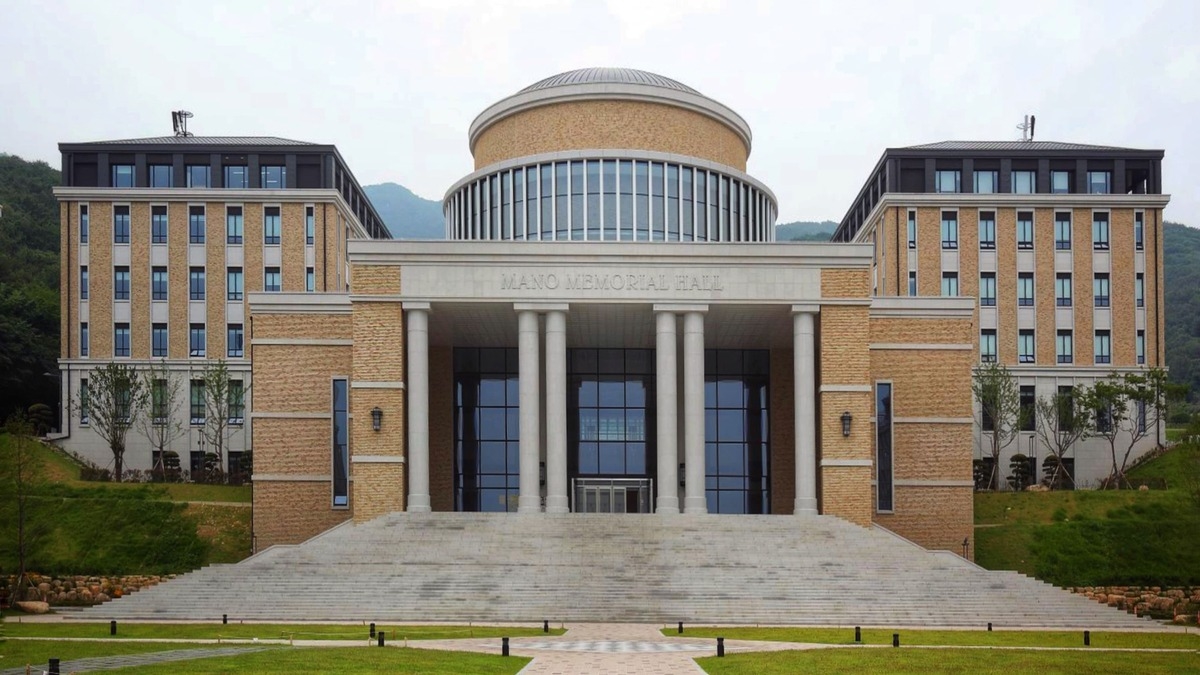 Opened in 2014, the Namsandong Campus at BUFS was designed by Japanese Nikken Sekkei Ltd. Jung says the connection came when, during a visit to Kansai Gaidai University with the then-president of BUFS, they were introduced to the company that had designed that campus. "This campus is a product of Japan-Korea exchange―one example of our collaboration with Japan," he notes. (Photo: lecture slide)
Education Is About Building Bridges Between People
I've rarely felt hardship in the education itself that I've been involved with; I enjoy working with students and doing activities together. What has been difficult is when, for students' sake, I've tried to change policies or systems and had to push back against government or university authorities. Unless you raise your voice in advocacy, policies and systems won't change, so I have sometimes pressed ahead even at the cost of friction―only to be misunderstood as "doing it for myself." I'm willing to take on anything that benefits students and Japan-Korea relations, but having society and organizations understand that has been the toughest part.
These days, 8 to 10 million or more Koreans travel to Japan every year. Out of a national population of roughly 50 million, that means one in four or five Koreans visits Japan―a very large number.
In 50 or 100 years, I believe there will be a bridge between Busan and Fukuoka. This is not a pipe dream. There's a tunnel under the English Channel between the United Kingdom and France, used by cars and trains. Within a century, Busan and Fukuoka will likewise be connected―by a bridge above or a tunnel below.
Speaking of bridges, there's a phrase, "Education is all a matter of building bridges," by the American writer and educator Ralph Ellison. The bridges in question link people to people, country to country, and field to field. He also says that educators cannot teach how to walk the road; what they can do is build the bridge called "opportunity." It is the learners themselves who walk the road over that bridge. I believe that is the meaning of education. It is the same idea behind the words of Professor Tohsaku Yasuhiko: "The significance of language education lies in creating connections."
Looking back, I realize that what I have been doing all along is trying to build continuous learning pathways for students and to create many kinds of ties with society. And I am newly convinced that building such bridges is the mission of those of us who work in education.
Thank you for your time today.
Lecture Contents (approx. 90 minutes)
・Busan, Gateway to Japan
・Division of Japanese, Busan University of Foreign Studies
・Innovation in Education and Research
・International Exchange and Social Contribution
・What Is the Meaning of Education?
Related articles
Bridging 100 Years of Mingei History: Marty Gross on the Path of the Film Archive
084 The 51st Japan Foundation Awards Report on the 2024 Japan Foundation Awards Ceremony

Back Issues
- 2026.3. 3 Busan as a Bridge: R…
- 2026.3. 3 Bridging 100 Years o…
- 2026.1.30 Crossing Borders thr…
- 2026.1.23 Weaving Memories of …
- 2026.1. 6 How Japanese-Languag…
- 2025.12.25 Peace Actions Envisi…
- 2025.9.30 The 51st Japan Found…
- 2025.9.30 The Japan Foundation…
- 2025.9.30 Bringing the World C…
- 2025.9.30 The 51st (2024) Japa…